


What Is Gotoh? A Guide to Japanese Guitar and Bass Hardware
The hardware on a guitar or bass may be small, but it has an important job. Tuning machines hold string tension, bridges establish string position and intonation, and tremolo systems must move smoothly while returning as consistently as possible. Even components such as saddles, bushings, string trees, and mounting screws can affect how an instrument functions.
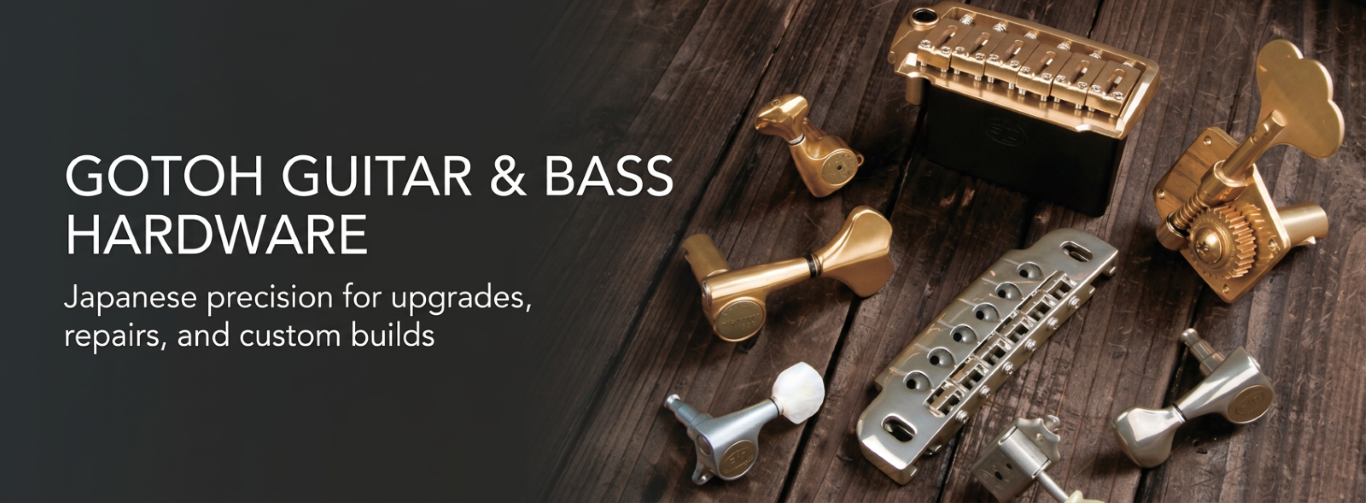
Gotoh is a Japanese manufacturer of hardware and replacement parts for stringed instruments. Its catalog includes guitar and bass tuning machines, fixed bridges, tremolo systems, tailpieces, locking nuts, saddles, strap hardware, and other components.
Musicians use Gotoh hardware to replace worn parts, restore older instruments, upgrade compatible guitars, and complete custom builds. The company offers both traditional designs and modern systems, making Gotoh relevant to players, repair technicians, and instrument builders.
Who Is Gotoh?
GOTOH GUT Co., Ltd. began manufacturing stringed-instrument parts in Japan in 1960. According to its official company profile, Gotoh is Japan’s only domestic manufacturer of machine heads.
Over the decades, the company has expanded beyond tuning machines to develop a broad selection of hardware for:
- Electric guitars
- Acoustic guitars
- Classical guitars
- Four-string and five-string basses
- Vintage-inspired restorations
- Modern performance instruments
- Custom guitar and bass builds
Gotoh parts are available in many configurations, dimensions, materials, button styles, and finishes. This variety is useful because instruments that look similar do not necessarily use interchangeable hardware.
Why Do Players and Builders Choose Gotoh?
Gotoh hardware appeals to customers looking for a balance of accurate manufacturing, practical design, broad compatibility options, and visual choice.
A Gotoh component may be selected for several reasons:
- Replacing damaged or worn original hardware
- Adding locking tuning machines
- Installing a new bridge or tremolo
- Restoring a vintage-style guitar
- Coordinating the finish of an instrument
- Building a guitar or bass from individual parts
- Trying different saddle or bridge materials
- Improving adjustment and maintenance
Not every hardware change produces the same result on every instrument. Correct installation, accurate setup, nut condition, string choice, and the instrument’s construction all remain important.
Gotoh Guitar Tuning Machines
Tuning machines are one of Gotoh’s best-known product categories. The company produces sealed, vintage-style, open-gear, locking, and premium tuning machines for different headstock layouts.
Common Gotoh guitar tuner families include SG301, SG381, SD90, SD91, and the 510 Series.
SG301 and SG381 Sealed Tuners
The SG301 and SG381 families include compact sealed-gear tuning machines for many electric and acoustic guitar applications. Options vary by headstock arrangement, post type, tuner button, locking mechanism, and finish.
Depending on the model, sets may be arranged for:
- Six-in-line headstocks
- Three-per-side headstocks
- Left-handed instruments
- Mixed or custom layouts
The specific model code matters. Two sets from the same family may use different buttons, posts, orientations, or locking systems.
SD90 and SD91 Vintage-Style Tuners
Gotoh SD90 and SD91 tuning machines provide a traditional appearance for compatible vintage-inspired guitars. They are offered in different layouts, finishes, and button styles.
Selected SD models are also available with modern locking mechanisms. This allows players to retain a vintage-style appearance while gaining the convenience of locking string posts.
Before replacing vintage tuners, compare the post diameter, bushing type, screw position, and headstock layout. A tuner that appears correct in a photograph may still require different mounting holes or bushings.
Gotoh 510 Series Tuners
The 510 Series represents Gotoh’s premium tuner range. It includes sealed, compact, open-gear, and vintage-oriented designs, depending on the model.
Available choices can include different tuner buttons, gear configurations, finishes, post types, and locking options. Decorative buttons may also be available in materials or styles that complement acoustic guitars and custom instruments.
What Are Gotoh Magnum Lock and MG-T Tuners?
Gotoh offers more than one type of locking tuner, so it is important to distinguish between the systems.
Magnum Lock uses string tension as part of its self-locking mechanism. As the string is brought to tension, the internal design secures it at the post.
MG-T, or Magnum Lock Traditional, uses a thumbscrew-style mechanism on the back of the tuner. The player inserts the string, tightens the rear thumbwheel, trims the excess, and tunes the instrument.
Locking tuners can provide several practical benefits:
- Faster and tidier string installation
- Fewer wraps around the tuner post
- Consistent string attachment
- Convenient string changes
- Reduced chance of poor winding technique
However, locking tuners do not automatically correct every tuning issue. Binding at the nut, improperly stretched strings, loose hardware, incorrect setup, or problems at the bridge can also cause instability.
Other Gotoh Tuner Technologies
Features differ between models, but several Gotoh technologies appear throughout the tuner catalog.
Rock Solid
Gotoh describes Rock Solid as a system designed to keep the string post stable, including during bending and tremolo use. A stable post also helps reduce unwanted movement within the tuner assembly.
Lubri-Coat
Lubri-Coat applies a solid lubricating layer to the worm gear. According to Gotoh, this helps establish effective contact between the worm and gear wheel while maintaining lubrication where it is needed.
H.A.P. and H.A.P.M.
H.A.P., or Height Adjustable Post, allows the effective string-post height to be adjusted on compatible models. This can help establish the desired string angle behind the nut.
H.A.P.M. combines an adjustable-height post with the Magnum Lock system. Availability depends on the tuner family and exact model.
Customers should check the individual product specifications because not every Gotoh tuning machine includes every technology.
Gotoh Tremolo Systems
Gotoh manufactures tremolo systems for vintage-inspired, modern two-point, and double-locking guitar designs.
Vintage-Style Tremolos
Traditional Gotoh tremolos include models with six mounting screws. These are designed for compatible vintage-style guitar bodies and may be available with different block materials, saddles, and finishes.
The GE101T and related models are examples of this general format. Even within a familiar vintage design, mounting spacing and block clearance must be verified.
Gotoh 510 Two-Point Tremolos
Gotoh’s 510 tremolo family includes premium two-point systems such as the 510T-FE1, 510TS-FE1, and 510TS-BS1.
Specifications vary between models. Depending on the version, differences can include:
- Tremolo block material
- Saddle material
- Block depth
- Finish
- Arm mechanism
- Included mounting hardware
For example, FE and BS model designations may identify different saddle configurations. Customers should compare the complete model number rather than selecting a bridge based only on its appearance.
GE1996T Double-Locking Tremolos
The Gotoh GE1996T is a double-locking tremolo system for compatible guitars. It is available in different finishes and block lengths, allowing customers to select a version suited to the instrument’s body depth and cavity.
A double-locking installation may also require a compatible locking nut and tension bar. Existing post spacing, cavity dimensions, nut width, and block clearance should be measured before ordering.
A technician may be required if installation involves routing, drilling, or permanent modification.
Gotoh Fixed Bridges, Saddles, and Tailpieces
Players who do not use a tremolo can choose from several Gotoh fixed-bridge designs.
Tele-Style Bridges
Gotoh produces both traditional three-saddle and modern six-saddle bridges for compatible Tele-style instruments.
Three-saddle models preserve a familiar vintage appearance. Modern six-saddle designs allow the position of each string to be adjusted separately.
Gotoh also offers In-Tune compensated saddles. Their shaped contact points are designed to provide improved compensation while retaining the character and adjustment format of a three-saddle bridge.
Depending on the product, brass and titanium saddle options are available.
Hardtail Bridges
Hardtail bridges such as the GTC101 provide individual saddle adjustment for compatible string-through-body guitars. They can be used for replacement projects or new builds when the mounting pattern and string spacing match.
Tune-O-Matic Bridges and Stop Tailpieces
Gotoh manufactures Nashville-style and ABR-1-style bridges, along with compatible stop-bar tailpieces. Material choices may include zinc, aluminum, steel, brass, or titanium, depending on the component.
Tune-O-Matic-style hardware is not universally interchangeable. Important measurements include:
- Post spacing
- Post diameter
- Thread type
- Bridge radius
- String spacing
- Saddle travel
- Tailpiece stud dimensions
Metric and imperial-looking components may appear almost identical while using incompatible threads or dimensions.
Gotoh Bass Hardware
Gotoh offers tuning machines and bridges for several bass configurations.
Bass tuner options include traditional open-gear designs, compact models, and premium series. Sets may be arranged for four-in-line, three-plus-one, two-plus-two, and five-string headstocks.
Gotoh bass bridges include products for four-string and five-string instruments. Examples include the 201B-4 and 205B-5 bridge families, with specifications varying by model.
Before choosing bass hardware, confirm:
- Number of strings
- Headstock orientation
- Post and bushing dimensions
- Mounting-screw positions
- Bridge mounting pattern
- String spacing
- Tuner weight
- Finish
Tuner weight can be particularly relevant on a bass because changing several machine heads may affect the instrument’s overall balance.
Classical and Acoustic Guitar Tuners
Gotoh also produces tuning machines for acoustic and classical guitars.
The 35G family includes classical guitar tuner sets in practical and decorative configurations. Available models may differ in plate design, roller specifications, gear construction, tuner buttons, and finish.
Open-gear acoustic tuners are another option for traditional or custom instruments. These models expose the gear mechanism and are often chosen for their appearance as well as their function.
Classical and open-gear tuners require careful measurement. Check roller or post spacing, plate length, screw locations, headstock thickness, and existing holes before installation.
Gotoh Accessories and Replacement Parts
A complete hardware replacement is not always necessary. Gotoh also manufactures smaller components for repairs, maintenance, and customization.
The available range includes:
- Tremolo arms
- Tremolo springs
- Spring claws
- Locking nuts
- String retainers
- Tuner bushings
- Strap buttons and strap locks
- Neck plates
- Jack plates
- Control plates
- Metal knobs
- Mounting screws
- Wrench holders
- Bridge saddles
Using the correct small part can help preserve the rest of the original assembly. Model compatibility remains important, especially for tremolo arms, bushings, screws, and saddles.
Are Gotoh Parts Universal?
No. Gotoh hardware is not universally compatible with every guitar or bass.
Terms such as “vintage-style,” “Tele-style,” “Strat-style,” “Nashville-style,” or “Floyd-style” describe general formats. They do not guarantee a direct fit.
Before ordering, compare the product’s technical drawing with the measurements of your instrument. Depending on the component, check:
- Mounting-hole spacing
- Tuner-post diameter
- Bushing dimensions
- Headstock layout
- Bridge post spacing
- String spacing
- Tremolo block depth
- Body cavity dimensions
- Nut width
- Screw dimensions and thread type
Gotoh notes that fitting its products to an existing instrument may require additional modification. If drilling, routing, or thread conversion is necessary, consult a qualified repair technician.
Frequently Asked Questions About Gotoh
Is Gotoh a Japanese company?
Yes. GOTOH GUT Co., Ltd. is a Japanese manufacturer based in Gunma, Japan. The company states that it began manufacturing stringed-instrument parts in 1960.
What products does Gotoh make?
Gotoh manufactures guitar and bass tuning machines, fixed bridges, tremolo systems, tailpieces, saddles, locking nuts, strap hardware, and many smaller replacement components. It also offers tuners for acoustic and classical guitars.
Are Gotoh locking tuners better than standard tuners?
Locking tuners are particularly convenient for quick, consistent string installation. They reduce the need for multiple wraps around the post, but they do not automatically solve problems caused by the nut, bridge, strings, or instrument setup.
What is the difference between Magnum Lock and MG-T?
Magnum Lock uses string tension as part of its locking action. MG-T uses a traditional rear thumbscrew that the player tightens to secure the string. Both systems are available only on designated tuner models.
Can Gotoh hardware be installed without modifying the instrument?
Sometimes, but not always. Installation depends on the exact dimensions of the original part and the selected Gotoh model. Compare technical drawings and measurements before assuming a part is a direct replacement.
How do I choose the correct Gotoh part?
Start with the full Gotoh model number, then verify its dimensions, orientation, finish, post or block size, mounting pattern, and included components. Do not rely only on the product photo or general style name.
Explore Gotoh Hardware at Kizai Music
Gotoh offers hardware for many types of repairs, restorations, upgrades, and custom builds. The range covers traditional designs, modern locking systems, premium tremolos, fixed bridges, bass hardware, classical tuners, and smaller replacement parts.
Explore the Gotoh collection at Kizai Music to compare tuning machines, bridges, tremolos, tailpieces, saddles, and accessories. Review the specifications carefully, measure your instrument, and contact a qualified technician when installation may require permanent modification.