

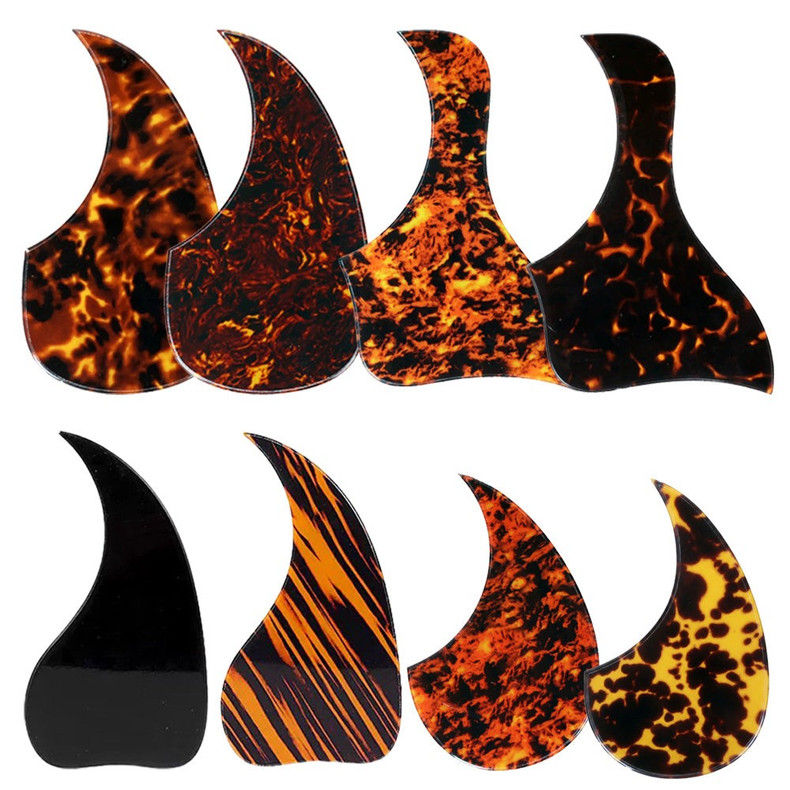
A pickguard protects the top of your guitar from pick scratches and strumming wear, and it changes the look of the instrument more than almost any other small part. The catch is that pickguards are not one-size-fits-all: each one is cut for a body shape, and two guitars that look similar can need different guards.
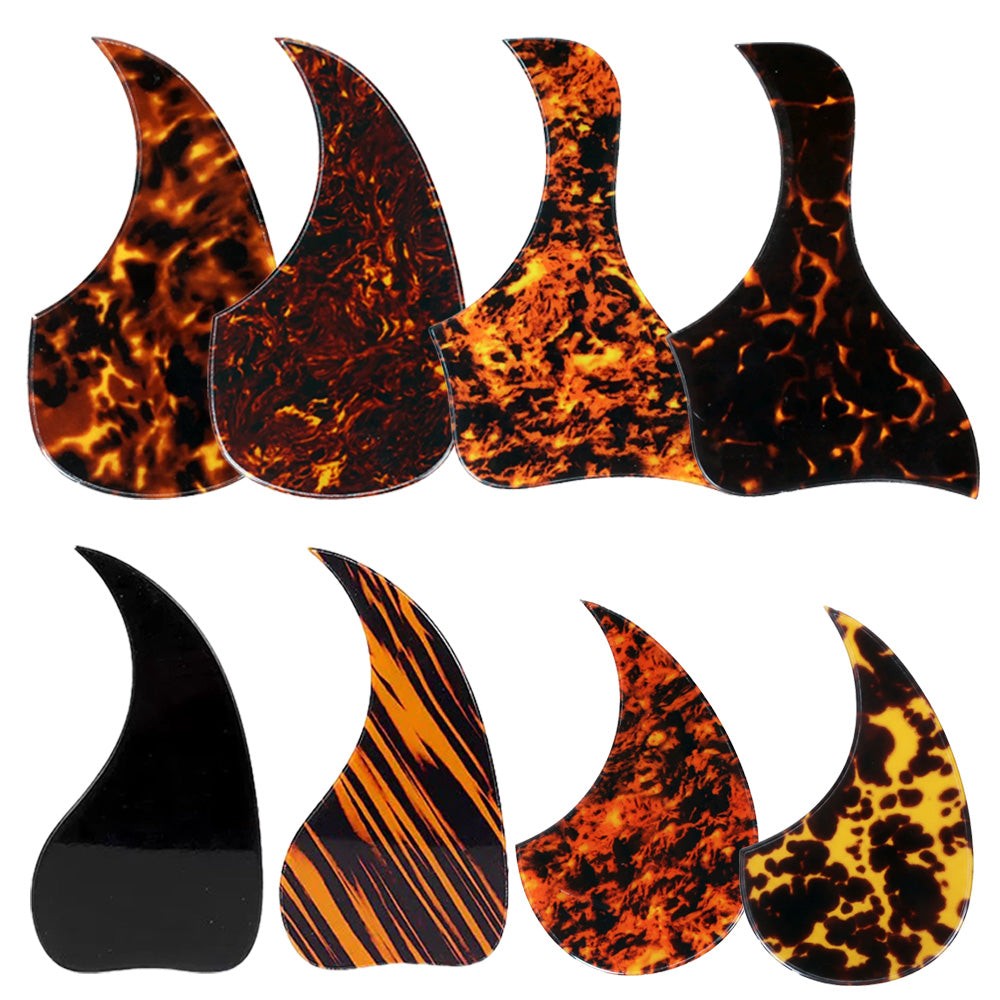
Acoustic pickguards come in several outlines. The shape has to match your guitar's body.
Here is how to choose the right one in a few minutes, with a ruler and a sheet of paper.
Step 1: Know your guitar's body shape
Acoustic pickguards are named after the body shape they are cut for. Find your guitar's shape first: look up the model name on the label inside the soundhole, and the maker's website will tell you the body shape.
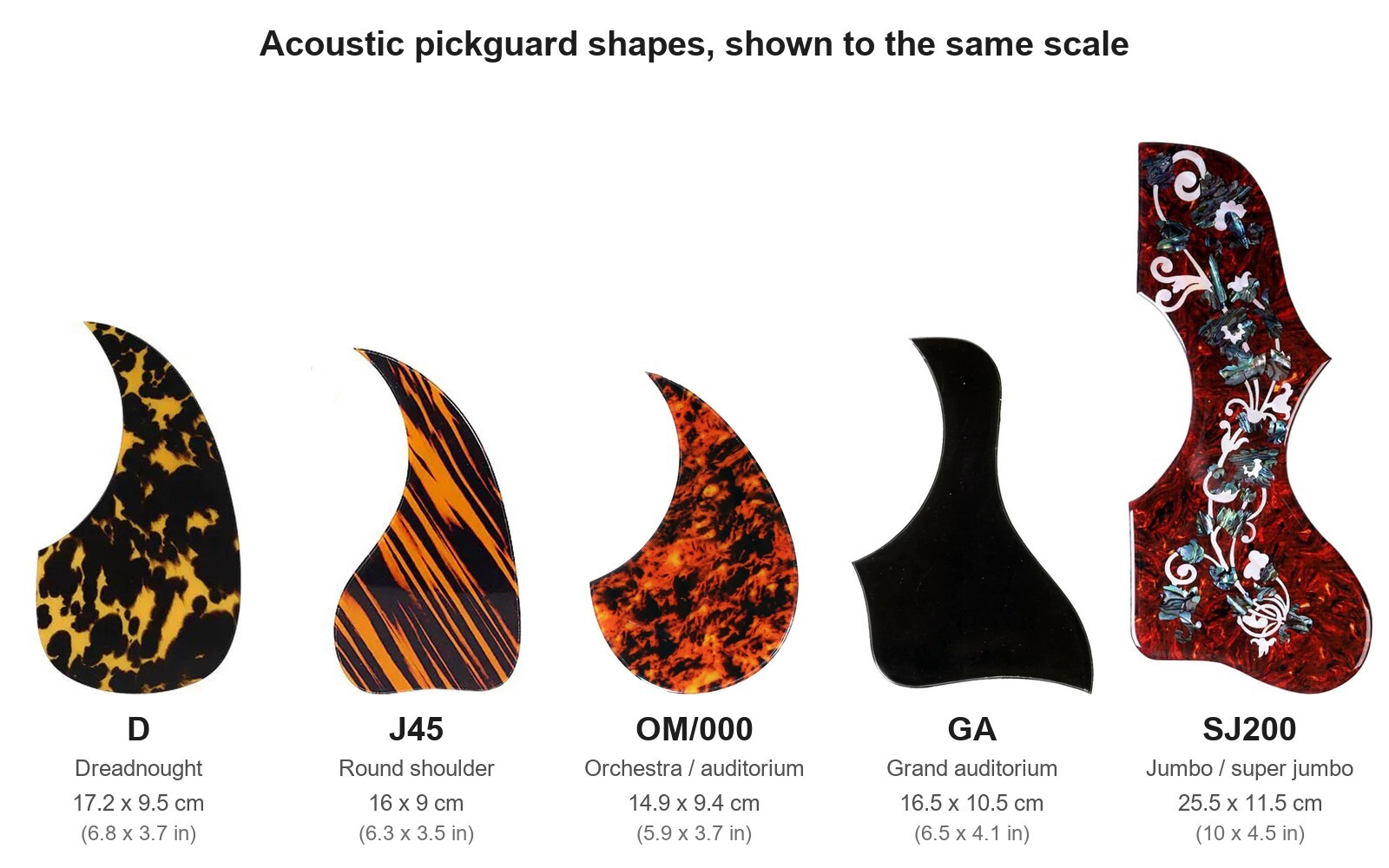
| Pickguard shape | Guitar body | Typical pickguard size |
|---|---|---|
| D | Dreadnought: the large, square-shoulder body | 17.2 x 9.5 cm (6.8 x 3.7 in) |
| J45 | Round-shoulder (slope-shoulder) dreadnought | 16 x 9 cm (6.3 x 3.5 in) |
| OM/000 | Orchestra model, 000 (auditorium) and similar smaller bodies | 14.9 x 9.4 cm (5.9 x 3.7 in) |
| GA | Grand auditorium: between OM/000 and dreadnought, with a streamlined, asymmetric guard | 16.5 x 10.5 cm (6.5 x 4.1 in) |
| SJ200 | Jumbo and super jumbo | 25.5 x 11.5 cm (10 x 4.5 in) |
Sizes are the PYLON pickguards we carry, measured by hand, so allow a small tolerance. Decorative D-shape models also come as a teardrop of about 17 x 9.7 cm (6.7 x 3.8 in), a small teardrop of about 14 x 8.8 cm (5.5 x 3.5 in) and a bird shape of about 16 x 11 cm (6.3 x 4.3 in).
A note on "41-inch" and "43-inch": these describe the overall length of the guitar, not the pickguard. A 41-inch guitar is a full-size dreadnought-size acoustic and 43-inch usually means a jumbo. Treat them as a hint for the body shape, then go by the measurements below.
Step 2: Measure your guitar
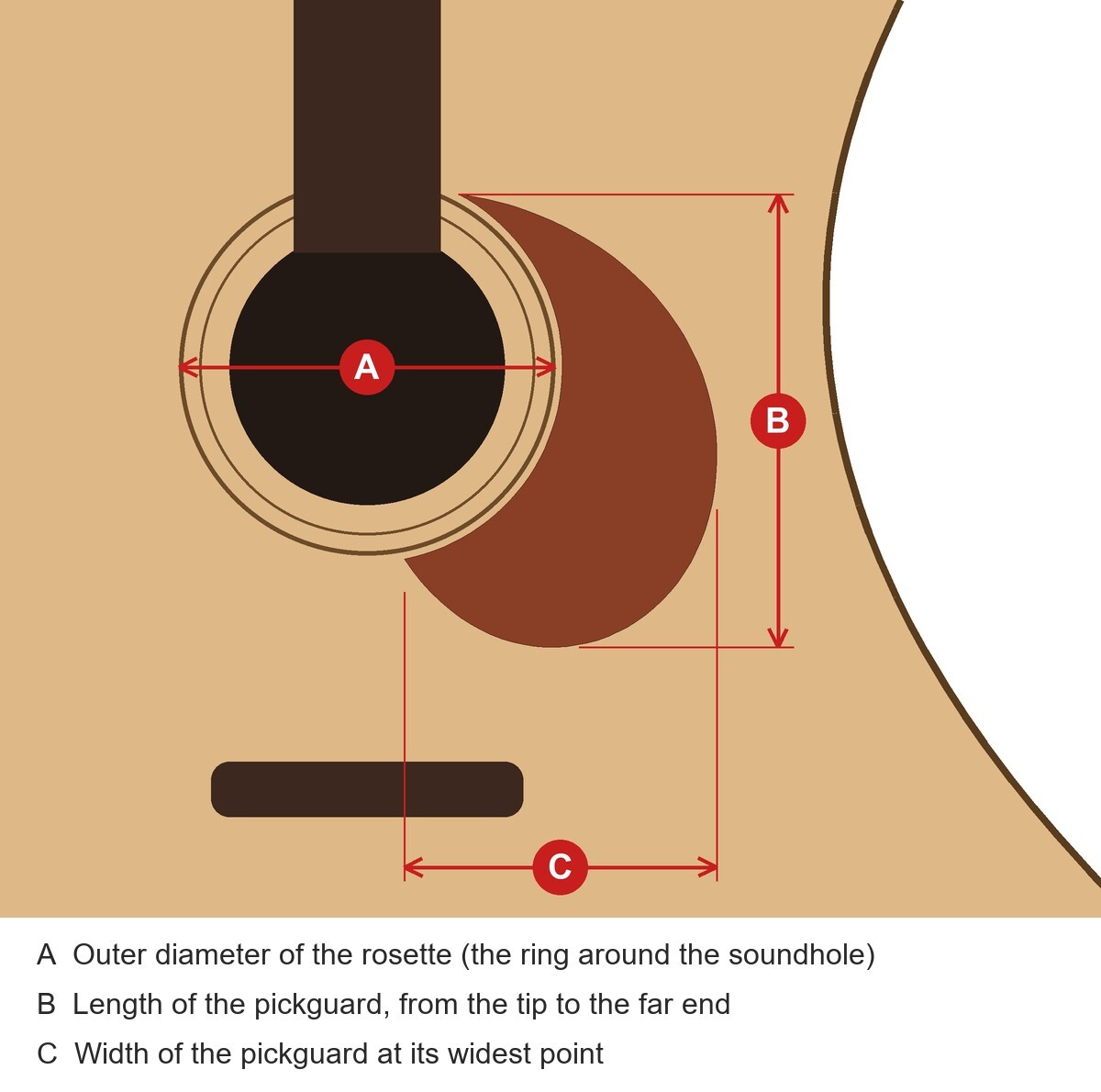
- A: the rosette. Measure straight across the outside of the decorative ring around the soundhole. The inner curve of a pickguard is cut to sit along this ring, so this number tells you how tight that curve needs to be.
- B: the length. Measure the space the pickguard can fill, from the point beside the fingerboard down toward the bridge. Stop short of the bridge.
- C: the width. Measure from the rosette out toward the edge of the top at the waist. Stop short of the edge binding.
Replacing an old pickguard? That makes it easy: measure the old one's length and width, and trace its outline onto paper. Choose a replacement in the same shape that is the same size or slightly larger, so it covers the outline the old one leaves on the top.
Adding one to a bare top? Cut a paper rectangle to the length and width in the listing and hold it beside the soundhole, tilted the way a pickguard sits. If the paper clears the bridge, the fingerboard and the edge of the top, the pickguard will too.
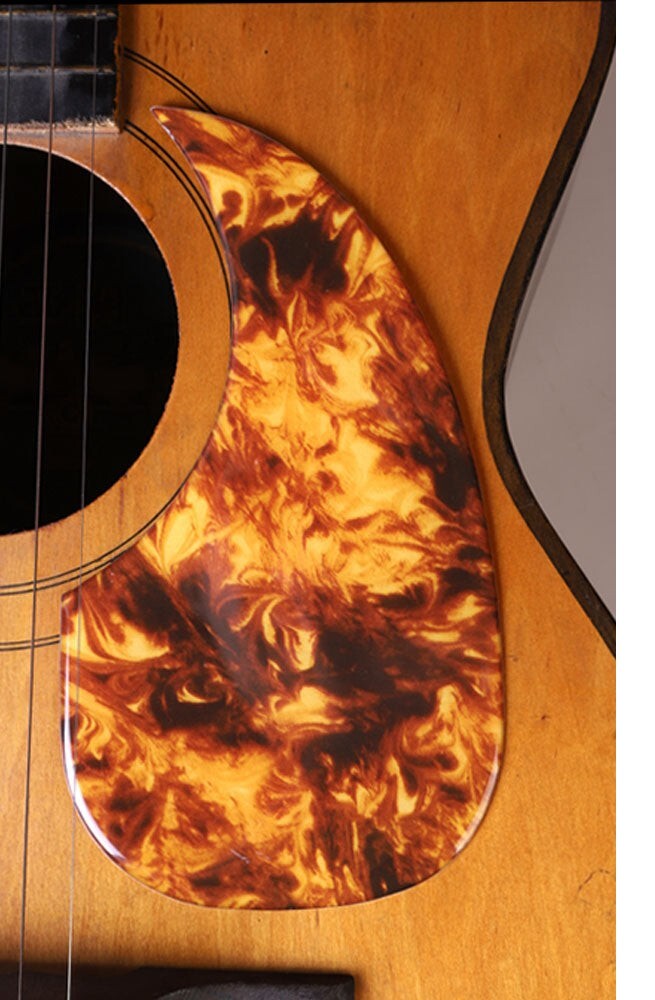
A well-matched pickguard follows the rosette and leaves space before the edge of the top.
Step 3: Compare with the listing
Every pickguard listing gives its shape and its length and width. Your shape from Step 1 should match the shape in the title, and the size should fit inside your measurements from Step 2. If your guitar is between two shapes, go by the measurements rather than the name.
Important: the size chart is a guide
Shape names are a shorthand, not a standard. Makers draw their bodies, soundholes and rosettes a little differently, so two "dreadnoughts" can still need slightly different guards. Hand-finished pickguards also vary a little from piece to piece. If your measurements sit right on the limit, or your guitar has an unusual body, contact us with its body shape and your A, B and C measurements before you order and we'll help you choose.
Step 4: Choose the material, thickness and look
- Tortoiseshell and celluloid-style patterns: the classic look, from light tiger stripe to deep brown and solid black.
- Clear or translucent: protects the top without hiding the wood. A good choice for a guitar that never had a pickguard.
- Thin models: a thinner guard, such as 0.78 mm (0.031 in), adds as little as possible to the top.
- Decorative and inlaid models: shell-style inlays, flowers and birds, mostly for D and SJ200 bodies. These are showpieces as much as protection.
- Edge finish: some models have a beveled edge that blends into the top. It's a detail worth checking in the photos.
Step 5: Fit it
Most acoustic pickguards, including the PYLON models we carry, are self-adhesive: peel and stick, no tools needed.

- Test the position first. Hold the pickguard in place with the backing still on and check it against the rosette, the bridge and the edge of the top.
- Clean the top. Wipe away dust and oil. Trapped debris causes air bubbles.
- Peel the backing carefully. Don't bend a flexible pickguard; it can crease.
- Apply it like a phone screen protector. Set the inner curve against the rosette first, then smooth the rest down from that edge outward.
- Fix bubbles right away. Lift that section, clean the surface and lay it down again.
- Remove the protective film. New pickguards have a clear film on the front. If it's hard to peel, rub an edge with your finger or warm it briefly with a hair dryer on low heat. Don't use sharp tools, and avoid high heat, which can deform the pickguard.
Right-handed or left-handed?
A pickguard is cut for one side of the soundhole, and the adhesive is on the back, so it can't be flipped over. Unless a listing says left-handed, it is for a right-handed guitar.
What about electric guitar pickguards?
Electric pickguards work differently: they are screw-mounted and made for a specific model, so you match rather than measure.
- Model: a Stratocaster pickguard only fits a Stratocaster, a Les Paul pickguard only fits a Les Paul.
- Screw holes: count them. A modern-style Stratocaster pickguard has 11 holes; vintage-style guards have fewer.
- Pickup layout: the cutouts must match your pickups, for example SSS for three single-coils.
- Hardware: a Les Paul pickguard is held by a mounting bracket, and replacement screws are sold separately.
Before you buy: a quick checklist
- Body shape: D, J45, OM/000, GA or SJ200?
- Rosette (A): measured across the outside of the ring?
- Length and width (B, C): does the listed size fit, clear of the bridge and the edge?
- Replacing an old one: same shape, same size or slightly larger?
- Handedness: right-handed unless the listing says otherwise.
- Look: tortoiseshell, black, clear or decorative?
Frequently asked questions
Are acoustic guitar pickguards universal?
No. Acoustic pickguards are cut for a body shape: dreadnought (D), round-shoulder (J45), OM/000, grand auditorium (GA) or jumbo (SJ200). Each has a different outline and size, so choose the shape made for your guitar's body and then check the measurements.
How do I know what size pickguard fits my acoustic guitar?
Identify your guitar's body shape, then measure three things: the outer diameter of the rosette around the soundhole, and the length and width of the space where the pickguard will sit (or of your old pickguard). Compare the length and width with the size given in the listing.
What is the difference between a D shape and a J45 shape pickguard?
A D-shape pickguard is the classic teardrop for square-shoulder dreadnoughts, about 17.2 x 9.5 cm (6.8 x 3.7 in). A J45-shape pickguard is cut for round-shoulder dreadnoughts and is slimmer and slightly shorter, about 16 x 9 cm (6.3 x 3.5 in). The outlines are different, so they are not interchangeable.
Will a dreadnought pickguard fit an OM or 000 guitar?
Usually not well. A D-shape pickguard is about 17.2 cm (6.8 in) long, against about 14.9 cm (5.9 in) for the OM/000 shape, so on a smaller body it can crowd the waist or the bridge. Choose the OM/000 shape and confirm with your measurements.
What does 41-inch or 43-inch mean in a pickguard listing?
It refers to the overall length of the guitar, not the pickguard. A 41-inch guitar is a full-size dreadnought-size acoustic, and 43-inch usually means a jumbo. Use it as a hint for the body shape, then check the pickguard's own length and width.
Can I add a pickguard to a guitar that never had one?
Yes. Self-adhesive pickguards stick directly to the top. Pick the shape for your body, measure the space beside the soundhole, and test the position with a paper cut-out before you peel the backing. If you want protection without changing the look, choose a clear pickguard.
How do I replace an old pickguard?
Measure the old pickguard's length and width and note its shape. Choose a replacement in the same shape that is the same size or slightly larger, so it covers the outline the old one leaves on the top. If the old pickguard is firmly stuck, or the guitar is valuable, have a repair shop remove it.
Can I use a right-handed pickguard on a left-handed guitar?
No. A pickguard is cut for one side of the soundhole and the adhesive is on the back, so it can't be flipped over. Unless a listing says left-handed, the pickguard is for a right-handed guitar.
Does a pickguard affect the sound of an acoustic guitar?
A thin, lightweight pickguard has very little effect on how the top resonates. If you want the lightest option, look for a thin model, such as a 0.78 mm (0.031 in) pickguard.
How do I remove the protective film from a new pickguard?
Rub an edge of the film gently with your finger until it lifts, or warm it briefly with a hair dryer on low heat. Don't use sharp tools, which can scratch the surface, and avoid high heat, which can deform the pickguard.
How do I choose a pickguard for an electric guitar?
Electric pickguards are screw-mounted and made for a specific model. Match the guitar model, count the screw holes (for example, 11 holes on a modern-style Stratocaster pickguard), and match the pickup layout, such as SSS. Les Paul pickguards also need a mounting bracket.